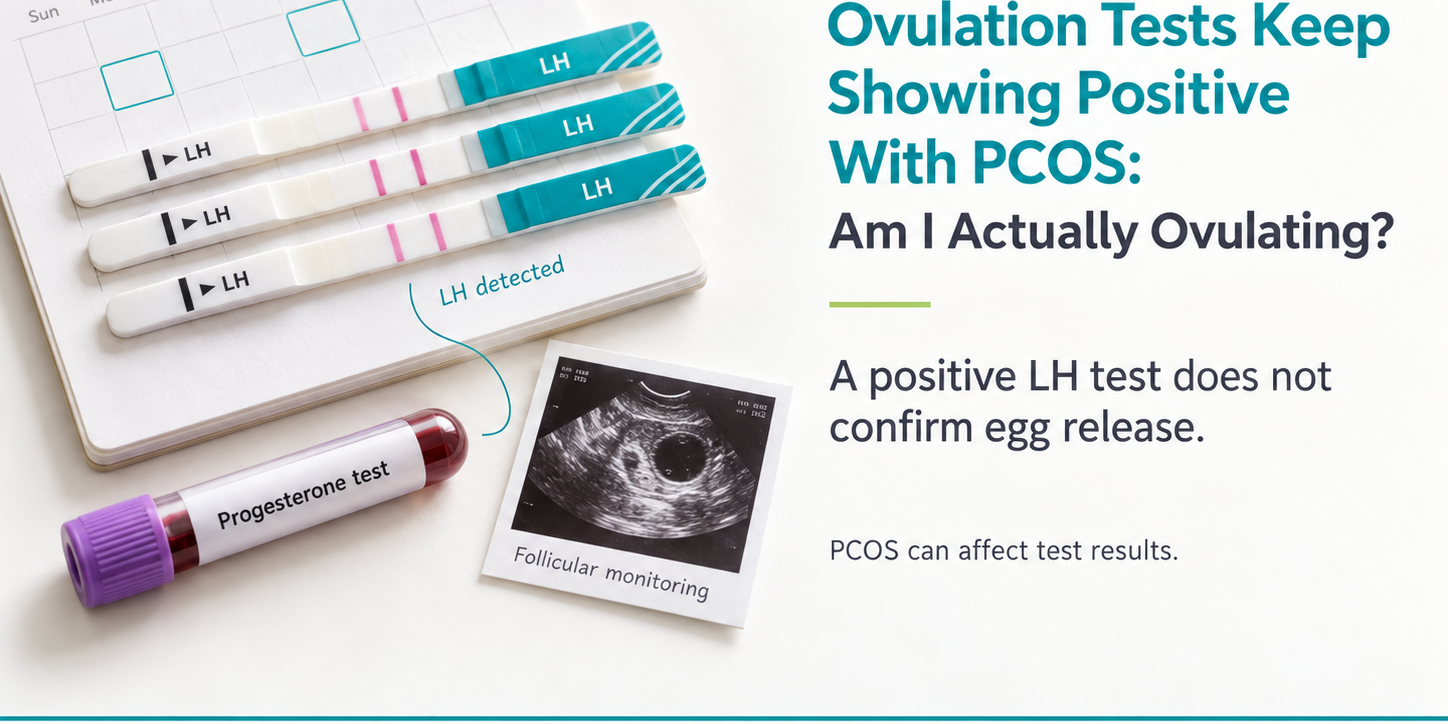
If you have Polycystic Ovary Syndrome (PCOS) and your ovulation tests keep showing positive, it does not necessarily mean you are releasing an egg. PCOS can cause higher or fluctuating levels of luteinising hormone (LH), which may make home ovulation predictor kits difficult to interpret. A positive result indicates that the test has detected LH, but it cannot confirm that ovulation has actually occurred.
This can be confusing, especially when you are trying to conceive and repeatedly see positive test strips without becoming pregnant.
Understanding how ovulation tests work, why PCOS affects their accuracy and which medical tests can confirm ovulation can help you make informed fertility decisions.
How Do Ovulation Tests Work?
Home ovulation predictor kits (OPKs) are designed to detect luteinising hormone in urine.
LH is produced by the pituitary gland, a small gland located at the base of the brain. It plays an important role in regulating the menstrual cycle.
In a typical ovulatory cycle, LH rises sharply shortly before an egg is released from the ovary. This increase is called the LH surge.
A positive ovulation test usually suggests that ovulation may occur within approximately 24 to 36 hours.
However, the test detects a hormonal change rather than the physical release of an egg.
According to the American Society for Reproductive Medicine (ASRM), urinary LH testing provides indirect evidence of ovulation and may produce false-positive or false-negative results.
For women with PCOS, interpreting these results can be more challenging.
Why Do Ovulation Tests Keep Showing Positive With PCOS?
PCOS affects the hormonal signals involved in egg development and release.
In some women, LH levels remain higher than usual even when the body is not preparing to release an egg.
Because ovulation kits detect LH, they may produce positive readings that do not represent a true pre-ovulation surge.
This may explain why you notice repeated positive results or several positive tests across the same menstrual cycle.
There are two important possibilities.
Higher baseline LH levels: Some women with PCOS have persistently elevated LH. An ovulation kit may detect these levels even without a genuine ovulatory surge.
Hormonal fluctuations without egg release: The body may experience LH changes without successful ovulation. A positive test therefore cannot establish that an egg has been released.
The ASRM fertility evaluation guideline specifically recognises that women with PCOS may have elevated baseline LH, resulting in false-positive urine ovulation tests.
However, this does not mean every positive test in someone with PCOS is incorrect. Some women with PCOS do ovulate naturally and may experience a genuine LH surge.
Does a Positive LH Test Confirm That an Egg Has Been Released?
No. A positive LH test cannot independently confirm ovulation.
The kit detects the hormonal signal that usually precedes egg release. It does not show whether a mature egg has actually left the ovary.
In a typical menstrual cycle, the LH surge stimulates a mature ovarian follicle to release an egg.
However, PCOS can interfere with normal follicle development and ovulation.
A woman may experience a rise in LH without completing the ovulatory process.
This is why repeatedly positive strips do not necessarily indicate multiple ovulations or several fertile windows.
If you are experiencing irregular cycles and uncertain ovulation test results, further evaluation may help determine whether ovulation is occurring.
Can You Ovulate Naturally Even if You Have PCOS?
Yes. PCOS does not mean that natural ovulation is impossible.
Some women with PCOS ovulate regularly, while others ovulate occasionally or experience cycles without egg release.
This variation depends on individual hormonal and reproductive factors.
Women with irregular periods may find it especially difficult to predict when ovulation will happen.
Even regular monthly bleeding does not completely guarantee ovulation.
The 2023 International Evidence-based Guideline for PCOS explains that ovulatory dysfunction can occur even when menstrual cycles appear regular.
Therefore, having PCOS does not automatically mean you are infertile, but menstrual patterns and home test results may not provide enough information about ovulation.
How Can You Confirm Whether You Are Actually Ovulating?
When home ovulation tests give confusing results, a gynaecologist may recommend more reliable methods of evaluating ovulation.
The choice depends on your menstrual history, fertility goals and whether you are receiving treatment.
1. Mid-Luteal Progesterone Blood Test
Progesterone is a hormone that rises after ovulation.
A blood test measuring progesterone can help determine whether an egg was likely released during the menstrual cycle.
For women with predictable cycles, the test is generally performed approximately seven days before the expected next period.
It is commonly called a day-21 progesterone test, but day 21 is not the correct testing day for everyone.
For example, if your menstrual cycle is longer or irregular, the appropriate testing date may be different.
ASRM states that a progesterone level above 3 ng/mL provides presumptive evidence of recent ovulation when measured at the appropriate time.
However, a single progesterone value cannot accurately assess the quality of the entire luteal phase.
For women with PCOS and unpredictable cycles, a doctor may recommend individualised testing rather than relying on a fixed calendar day.
2. Follicular Monitoring Ultrasound
Follicular monitoring involves ultrasound examinations to observe developing follicles inside the ovaries.
A follicle is a small fluid-filled structure that contains an immature egg.
During monitoring, the doctor assesses whether a follicle is growing and may look for changes suggesting that ovulation has occurred.
Serial ultrasound examinations can provide useful information, particularly when ovulation is unpredictable or fertility medicines are being used.
However, follicular monitoring is not necessary for every woman with PCOS.
It is generally considered when the findings will help guide fertility evaluation or treatment.
3. Menstrual Cycle and Symptom Assessment
Your menstrual history can also provide information about ovulation.
Regular menstrual cycles often suggest that ovulation is occurring, although they do not confirm it in every case.
Some women observe changes in cervical mucus or basal body temperature around ovulation.
However, these signs have limitations and should not be treated as definitive confirmation.
Basal body temperature changes usually occur after ovulation, making them less useful for predicting the best time to conceive.
Your doctor can help determine whether additional investigations are necessary.
Can You Get Pregnant if Ovulation Tests Are Unreliable?
Yes. Pregnancy remains possible with PCOS, including when home ovulation tests do not provide clear results.
Successful conception depends on an egg being released, sperm reaching the egg and other reproductive factors functioning appropriately.
If you ovulate naturally, pregnancy may occur even when an ovulation predictor kit fails to identify the fertile window accurately.
For couples trying to conceive, timing intercourse only around repeated positive strips may be confusing.
The ASRM guidance on optimising natural fertility explains that intercourse every one to two days during the fertile window can support conception.
When ovulation timing is uncertain, regular intercourse approximately every two to three days throughout the cycle may be a more practical approach, depending on personal preferences.
However, intercourse timing alone cannot overcome persistent absence of ovulation.
If you have very irregular periods or repeatedly uncertain results, a fertility evaluation may be helpful.
Should You Continue Using Ovulation Test Kits if You Have PCOS?
You do not necessarily need to stop using ovulation kits, but it is important to understand their limitations.
Some women with PCOS find that home LH testing provides useful information when they experience identifiable surges.
Others receive persistently positive or unpredictable readings that make the tests less useful.
If you are using an ovulation kit, follow the manufacturer’s instructions carefully.
Different products may use different thresholds and testing methods. Repeated testing with different brands can sometimes create additional confusion.
Consider recording your menstrual dates and test results so that your gynaecologist can review the pattern.
If your results remain positive for several days or repeatedly change without a clear cycle pattern, discuss whether progesterone testing or ultrasound monitoring would provide more useful information.
Avoid using LH strips as pregnancy tests. If your period is late and pregnancy is possible, use a pregnancy test designed to detect hCG.
What Treatment Helps When PCOS Is Preventing Ovulation?
If medical evaluation confirms that you are not ovulating regularly, treatment may help improve the chances of conception.
The recommended approach depends on your age, symptoms, metabolic health and whether other fertility factors are present.
Lifestyle measures, including balanced nutrition, regular activity and appropriate weight management, can support overall health and may improve reproductive function in some women.
However, lifestyle changes alone are not sufficient for everyone.
When medication is needed to induce ovulation, a doctor may consider letrozole.
The 2023 International PCOS Guideline recommends letrozole as the first-line pharmacological treatment for women with PCOS-related anovulatory infertility when no other infertility factors are present.
Other options, such as clomiphene citrate, metformin or gonadotrophin injections, may be appropriate in selected circumstances.
These medicines differ in effectiveness, monitoring requirements and possible side effects. Some fertility treatments can increase the likelihood of multiple pregnancy.
Treatment should be prescribed and monitored by a qualified healthcare professional.
Do not begin ovulation-inducing medicines without medical supervision, and pregnancy must be excluded before starting such treatment.
When Should You Consult a Gynaecologist About Repeated Positive Ovulation Tests?
A consultation may be helpful if ovulation kits repeatedly show positive results, your cycles are unpredictable or you are unsure whether ovulation is occurring.
You should also discuss your concerns if your periods are absent for several months.
Long gaps between periods in PCOS may require treatment to protect the uterine lining, even when pregnancy is not your immediate goal.
For women trying to conceive, evaluation is generally recommended after 12 months of regular unprotected intercourse if younger than 35, or after six months if aged 35 or older.
However, you do not necessarily need to wait this long when you have known PCOS with very irregular or absent ovulation.
A fertility assessment may include menstrual history, confirmation of ovulation and evaluation of other factors, including sperm health when relevant.
Frequently Asked Questions
1. Why Is My Ovulation Test Positive for Five Days With PCOS?
Repeated positive results may occur because LH levels are persistently elevated or fluctuate in PCOS. However, test sensitivity and individual hormone patterns can also influence results. Several positive tests do not prove that ovulation has happened. A progesterone blood test or appropriate ultrasound monitoring may help clarify the situation.
2. Can I Have Regular Periods but Still Not Ovulate With PCOS?
Yes. Although regular periods usually suggest ovulation, some women with PCOS experience cycles without egg release despite apparently regular bleeding. If confirmation is clinically necessary, your gynaecologist may recommend appropriately timed progesterone testing.
3. Do I Need IVF if I Am Not Ovulating Naturally Because of PCOS?
Not necessarily. Many women with PCOS-related ovulation difficulties can consider ovulation-inducing treatment before IVF. Letrozole is commonly recommended as the first-line medicine when anovulation is the main fertility problem. IVF may be considered if other treatments are unsuccessful or additional fertility factors are present.
Conclusion
Repeated positive ovulation tests with PCOS do not necessarily mean that you are ovulating regularly.
Higher baseline LH levels and hormonal fluctuations can make home test strips difficult to interpret. Although some women with PCOS release eggs naturally, others may need further evaluation to confirm ovulation.
A properly timed progesterone blood test, menstrual history review or follicular monitoring may help identify whether egg release is occurring and whether treatment is necessary.
If your ovulation tests repeatedly show positive results or you are finding it difficult to conceive, consult Dr. Bharati Hiremath at Hiremath Maternity Hospital for an individual assessment of your menstrual and reproductive health.
For personalised guidance on PCOS Treatment in Pimple Saudagar, discuss your ovulation test results, menstrual patterns and suitable fertility management options with a qualified gynaecologist.